Burnham line · Daniel's great-great-grandfather
Erastus Williams Burnham
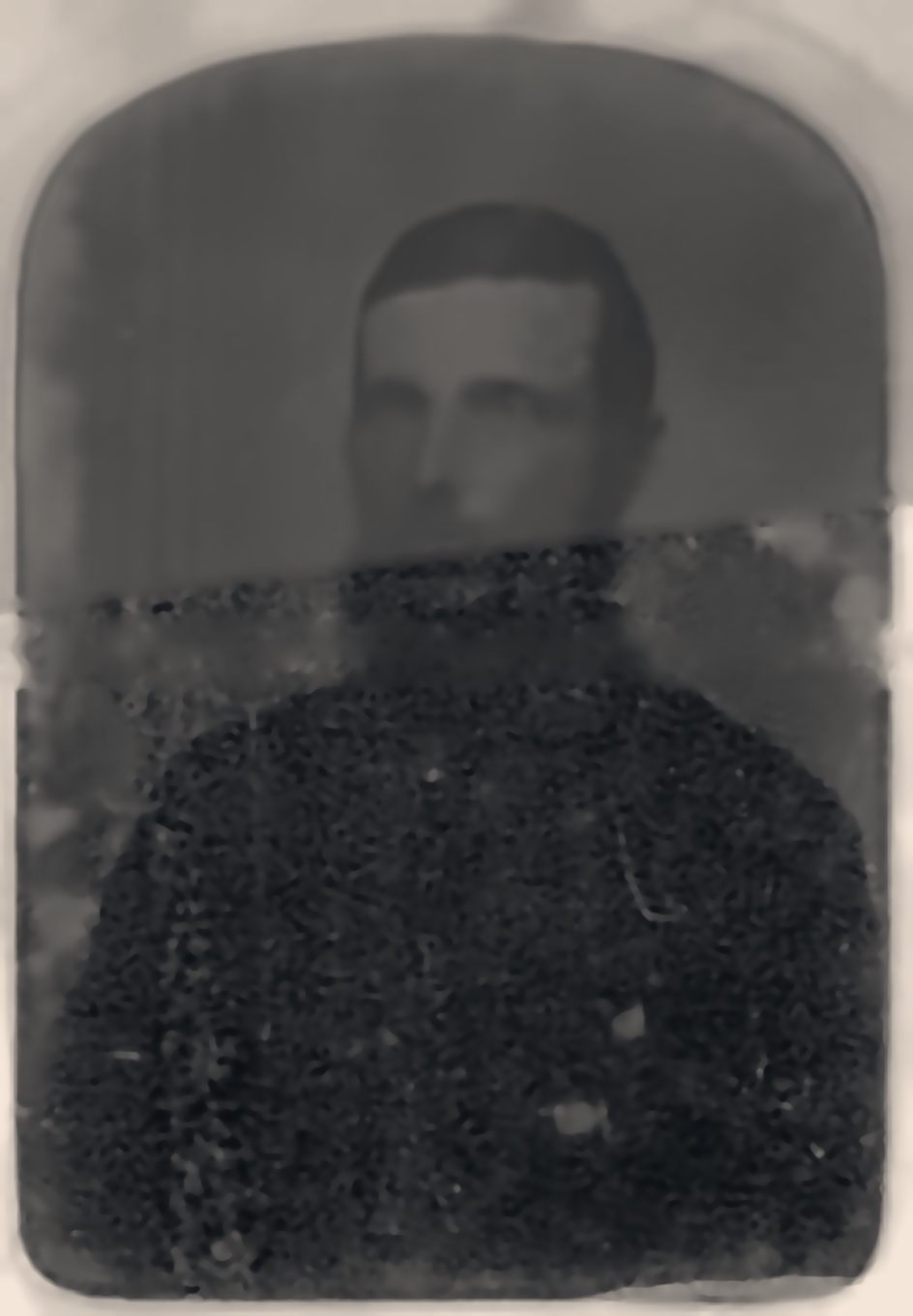 In uniform, 1862–65; tintype, Watershed History Collective 2004.09.013 (digitally restored) | |
| Born | 28 April 1834, South Windsor, Connecticut |
|---|---|
| Died | 11 April 1921 (aged 86), South Windsor, Connecticut |
| Resting place | Center Cemetery, South Windsor |
| Other names | Erasthus (family name); "Bill" (to his wife); "Erastus W. Brunham" (1851 crew list); "E. W. Burnham" (newspapers) |
| Occupation | Whaleman; policeman in Hong Kong; brass moulder; paper-mill worker; tobacco farmer; engine-room foreman |
| Military service | Union Army, Co. A, 12th Connecticut Infantry (1861–1862); Co. A, 1st Connecticut Heavy Artillery (1864–1865) |
| Spouse | Mary Graham Devine Burnham (m. 1855; died 1911) |
| Children | William Burnham (1856), Owen W., Charles Lee Burnham, Emmeline M. Burnham Kenyon, Agnes Maria Burnham, Henry Erastus Burnham, Frederick Burnham, Robert L. Burnham, Erastus Devine Burnham |
| Parents | Erastus Williams Burnham Sr; Emeline Parsons Burnham |
| Relatives | Abigail Burnham (sister); William Burnham Krug (grandson); Daniel St. John (great-great-grandson) |
Erastus Williams Burnham (28 April 1834 – 11 April 1921), known in his family as Erasthus, was an American whaleman, Civil War soldier, mill worker and tobacco farmer of South Windsor, Connecticut.[1][2] He sailed on the New London whaleship Hannibal in 1851, served on the police force of Hong Kong in 1853, and enlisted twice in the Union Army, in the 12th Connecticut Infantry and the 1st Connecticut Heavy Artillery.[3][1] His letters and papers are held by The Watershed History Collective (formerly the Wood Memorial Library & Museum) in South Windsor as the Erastus W. Burnham Collection.[1] He was the great-great-grandfather of Daniel St. John, who heard his stories from Erasthus's grandson William Burnham Krug.[4]
Name
The museum's person record and a biographical encyclopedia of about 1922 give his name as Erastus Williams (or William) Burnham.[1][2] The family, and Daniel St. John on the recordings made for The Book of Daniel, called him Erasthus, and Daniel once also called him "Erasmus".[5][6] His wife called him "Bill", and his sister Abigail Burnham called him "Brother Bill".[1] The New London clerk who entered him on the Hannibal's crew list in 1851 wrote "Erastus W. Brunham".[3]
Early life
Burnham was born in South Windsor on 28 April 1834, the son of Erastus Williams Burnham Sr and Emeline Parsons Burnham, and was the first of their eleven children.[1][2] His father farmed in South Windsor and was for a time foreman in a brad factory.[2] He was educated in the public schools of South Windsor.[1][2] His religious affiliation was with the Second Advent Church of South Windsor.[2]
In 1916, on his eighty-second birthday, he told The Hartford Courant that he had been born "within a mile from where he now lives, across from 'The Maples'".[7] He recalled that at fourteen, "with a companion and a few dollars he decided to see the world", going from Hartford to New York by steamboat while the railroad and steamboat companies were cutting fares. "After seeing the 'Big Town'" he was glad to return home, "where he remained until he was 17."[7]
Whaling voyage (1851–1853)
At seventeen he went to sea, shipping on a whaling vessel, by the encyclopedia's account, "for a period of three years".[2] On 21 June 1851 he was entered on the crew list of the ship Hannibal of New London as "Erastus W. Brunham", of South Windsor, aged eighteen, five feet six inches tall, with light complexion and light hair; no rank or lay was recorded.[3][8] The original list, filed at New London and now at the National Archives, carries no later note of his leaving the ship; on the published scan the surname could be read either "Brunham" or "Burnham".[9] The Hannibal (Hannibal (whaleship); Whaling History vessel AS1529, a ship of 441 tons built in New York in 1821) sailed from New London for the North Pacific on 24 June 1851 under Captain Jeremiah Lester Jr., with thirty-one men on her crew list.[10][3] She is not to be confused with the older Hannibal of Sag Harbor (AS1530).[11]
Four of his letters from the voyage survive in the museum's "Letters From the Sea": to his father on 13 June and 24–25 July 1851, to his mother on 17 August 1851 (naming the Western Islands, the Azores), and to his parents on 29 September 1852 from what he called the "Kamchatka Sea".[12] The Hannibal called at Fayal in the Azores in July and August 1851, was at Mangonui, New Zealand, in January 1852, and spent the summer of 1852 whaling north of the Bering Strait, where the Betsey Williams of Stonington spoke her on 31 August.[13][14] His September 1852 letter names the ship Vesper of New London and a "Captain House"; the Vesper's master, Edward M. Howes of Glastonbury, had been killed by a whale on 15 July 1852.[12][15] The Hannibal anchored at Ascension Island (Pohnpei) on 20 November 1852 and reached Hong Kong in February 1853, sailing again on 27 February.[16][13]
His own recollections, given to the Courant at eighty-two, add detail that no other source records. He said his father went with him to New London, and that the Hannibal sailed round the Cape of Good Hope; the captain, "fearing desertion by the larger part of his crew", kept away from the Australian gold country and cruised to New Zealand.[7] He remembered a whale that towed his boat for miles off New Zealand on Christmas Day 1851 before breaking away. He pulled stroke oar in the second mate's boat, which he said took seventeen whales; the largest, of 225 barrels, was taken "when coming through the Bering Straits".[7] In 1914 he said that for nineteen months he "never touched old Mother Earth's soil".[17]
The Hannibal returned to New London on 4 April 1854, but by then Burnham had left her.[10][1] The ship's records do not say when or how he left; her call at Hong Kong in February 1853 is the only occasion that fits his service there.[8] His obituary says that "after cruising two years in this vessel, he left the ship at Hong Kong, China".[18] His own account, in 1916, was that when the ship put into Hong Kong "Mr. Burnham and a companion fled to the island of Mecca [probably Macao] until the ship left port as they would have been compelled to finish the voyage."[7] According to family tradition the crew mutinied over their treatment, and Daniel St. John supposed they may simply have gone ashore and not returned.[19][20]
Hong Kong (1853)
In 1853 he served on the police force in Hong Kong.[1][2] His obituary says he "joined the British police force, serving in that city".[18] In 1914 he said he served there six months, "at which time there was only one other Yankee policeman on the force"; in 1916 he described the force as "mostly made up of Americans, Englishmen and Irishmen, with Chinese ministers as interpreters", whose night squad "all carried carbine guns".[17][7] He said officers who met resistance would "tie the whole bunch together by their 'pig-tails'" and march them to the squad house.[7]
He told of the capture of a pirate vessel in the harbour: his squad "floated out in different directions in sampans and completely surrounded the vessel capturing the crew of twenty-seven pirates, all of whom were beheaded."[7] The obituary gives the crew as twenty-eight.[18] No independent account of the capture has been found.
The family recalled that while on patrol he was attacked by seven bandits, stabbed seven times in the back and thrown off a bridge, and that he survived and later showed the scars to his grandson.[19] The museum's record does not mention the attack.[21] The encyclopedia article of about 1922 states that he "saw Commodore Perry's fleet on its memorable voyage to Japan in 1854", and the obituary that "while at Hong Kong, he saw Perry's fleet which was on its way to open the ports of Japan to the world"; Perry's squadron used Hong Kong as its depot between April 1853 and January 1854.[2][22] The Hong Kong Blue Book for 1853, which lists the colony's police, has not yet been searched for his name.[8]
Passage home (1853–1854)
By his 1916 account, "July 1, 1853, Mr. Burnham resigned from the Hong Kong police force and on the 4th shipped on the Challenge, bound with a cargo of tea and silk for New York." The ship sailed from "Wampolo" (probably Whampoa) on the 12th and "sprung a leak off the island of St. Helena", so badly that she put into the Azores, "where the crew was discharged".[7] He then "shipped on a barge for New Bedford, where he ended his seafaring career."[7] The obituary names the vessels: he left the clipper Challenge in the Azores "and came to New Bedford on the bark Grampus", adding that the Challenge, "after leaving Port Haute [probably Horta, Fayal], was never heard from again."[18]
Contemporary shipping news confirms the two ships but does not name him (see Challenge (clipper) and Grampus (bark)). The clipper Challenge, Captain Pitts, sailed from Canton on 13 July 1853 bound for London, not New York, and put into Fayal "very leaky" on 20 October.[23][24] She did not vanish: she reached Deal, for London, on 20 December 1853.[25] The bark Grampus, Captain Donnell, sailed from Fayal on 24 January 1854 with whale-ship oil and arrived at New Bedford on 7 March.[26]
Marriage and the coasting years (1855–1861)
On his return he learned the trade of moulder in a brass foundry in Holyoke, Massachusetts.[1][2] The obituary says instead that he "worked as a paper maker in Holyoke", and he said in 1916 that he worked there "in a paper mill from which the Hartford Courant Company bought its paper".[18][7] The museum dates his marriage to Mary Graham Devine (Mary Graham Devine Burnham) 15 May 1855; the obituary says he married "Mary G. Devine of Glasgow, Scotland, in Holyoke, May 16, 1855".[1][18] She had been born in Glasgow and had come to America in 1853.[2] Their first child, William (William Burnham (1856)), was born on 3 April 1856 and died that December.[2]
Three more of his letters filed among the "Letters From the Sea", dated 5 May 1857, 14 May 1857 and 21 June 1858, are addressed to Mary and name the sloop Mary Elizabeth of Middletown and her master, Captain Warren Taylor, with places including Middletown, Higganum, Hartford, Norwich, New York and the Hudson River.[12] A sloop Mary Elizabeth under a master named Taylor is recorded arriving at New York from Norwich, bound for Rondout, on 26 May 1858; that this was his sloop rests on the master's name only.[27] Mary's letter to him of 4 October 1858 survives as a photocopy.[12][28] Before the war he worked in South Windsor paper mills, for Wood & Keeney and then for the Parsons mills.[1][2]
Civil War
12th Connecticut Infantry
On 28 December 1861 he enlisted at Hartford as a private in Company A of the 12th Connecticut Volunteer Infantry; the regiment's 1862 roll describes him as twenty-seven, married, and a paper-maker.[29][30][31] The regiment sailed for Ship Island, Mississippi, early in 1862, and his letters to Mary in March and April come from Ship Island and from the ship E. W. Farley anchored off it (E. Wilder Farley (ship)).[32][33] The regiment went on in the Farley to the passes of the Mississippi and lay at anchor in her off New Orleans on 30 April 1862.[34] His letter of 28 April 1862 was written on the Mississippi River and names Fort Jackson and Commodore Porter, and that summer he wrote from Camp Parapet and Jefferson City, Louisiana.[33]
The state's 1889 roster records his discharge for disability on 29 July 1862, and the 1921 obituary an honorable discharge in July 1862, while the museum gives the official date as 14 January 1863 and the 1922 encyclopedia says July of the following year.[29][18][1][2] His last letter from Louisiana is dated 15 August 1862.[33]
In 1914 he said he had enlisted "under Captain George N. Lewis, for three years, at the end of which time he received an honorable discharge", which the rolls contradict, and that he "took no part in active fighting during his first enlistment".[17][29] In 1916 he remembered that when General Butler marched his men through New Orleans "torrents of abuse were poured on the Union soldiers", but Butler's discipline was such "that the men would not retaliate to abusive language from women and children under any circumstances."[7]
1st Connecticut Heavy Artillery
On 5 January 1864 he re-enlisted at South Windsor in Company A of the 1st Connecticut Heavy Artillery, a siege-artillery regiment.[35][36] His letters give his unit several ways, including the "7th … Artillery", but the museum records it as Company A, First Regiment Connecticut Volunteers Heavy Artillery.[21] Company A spent the winter of 1864 at Fort Reynolds in the defences of Alexandria, Virginia, and went to Bermuda Hundred in May 1864 to join General Butler's forces.[33][37] He wrote to Mary from the lines before Petersburg during the siege, from Broadway Landing in August 1864, from the regimental hospital on 17 September 1864, and from Fort Morton, where his company manned mortars, through the autumn and winter.[33][37]
In his own later accounts he was a gunner. He said the company "left Fort Darlin [Darling] for Petersburg" on 16 May 1864, "where for eight months they were under constant fire", and that he had been at Drewry's Bluff.[7][17] Once he "had changed places with a gunner when scarcely ten seconds later two men were killed on the spot he had just left", and he kept "a bullet which went through his blankets and the leg of his trousers, just grazing his leg".[7] Of the Crater, on 30 July 1864, he said in 1914 that "he tended an eight-inch mortar, firing the third shot fired in the battle".[17] The same account names his regiment once as the "Second" Connecticut Heavy Artillery, against the rolls.[17][35]
Whether he was wounded at the Crater is disputed. In 1916 he said "at the battle of the Crater he was shot in the shoulder"; the 1921 obituary says he fought there "where he was wounded", and the encyclopedia of about 1922 that he "was severely wounded".[7][18][2] The state's 1889 roster records no wound, and his 1914 account mentions none, although the same newspaper page says his neighbour Edwin Munsell, of the same two companies, "was struck with a musket ball in the shoulder".[35][17] He served to the end of the war and was mustered out on 25 September 1865; he gave the date in 1916 as "September 5, 1865", after the regiment had been "kept in the South for the summer".[35][1][7]
Later life
After the war he bought a tobacco farm in South Windsor and ran it for sixteen years.[1][2] In 1883 the family moved to Holyoke, where he worked for the Chemical Paper Company and then as foreman of the engine room at George R. Dickinson's paper mill, at a daily wage that rose from $1.87½ to $3.50 by 1899.[2] In Holyoke he belonged to the First Hose Company and to Kilpatrick Post No. 71 of the Grand Army of the Republic, for which four dues receipts of 1885–1890 survive; the post's painted roster of members for 1890, photographed at Caledonian Hall in the 1960s, lists "Burnham, E. W., A. 12th Conn."[1][38][39] His daughter Agnes married William Krug in Holyoke on 1 October 1890.[40] He was also a member of the Grand Army in Manchester, Connecticut, and later of Rodman Post of East Hartford.[2]
In 1899 he returned to South Windsor, where he farmed and grew tobacco at 235 Pleasant Valley Road until his death.[1][2] The newspapers of 1914 and 1916 place him on Depot Street, living with his sons, and the obituary calls him "a successful tobacco grower".[17][7][18]
In October 1913 he was visiting "his daughter Mrs. Kruz [Krug] of South Hadley, Mass."[41] On Memorial Day 1914 the Courant pictured him first among South Windsor's surviving Civil War veterans, saying that he had "a very interesting history of all the men in the First Connecticut Heavy Artillery" and "one of the best farms in town".[17] At eighty-two he read the Courant for two hours every morning.[7] Between about 1914 and 1916 he revisited the Petersburg battlefields, where his son Frederick A. Burnham owned "a 400-acre plantation on which are the breastworks which were familiar to the father fifty years ago".[7]
He kept a ribbon from the Battle Flag Day parade in Hartford of 17 September 1879, for the 12th Connecticut Volunteers, and a postcard of May 1912 announcing the 24th reunion of the 1st Connecticut Heavy Artillery Association.[38] He received pension certificates dated 1 July 1904, 17 May 1909 and 7 August 1912.[38] Mary died in 1911, after fifty-six years of marriage, and the 1922 encyclopedia names him among the children of his parents who celebrated golden wedding anniversaries.[2]
Death
He died at his home in South Windsor on the morning of 11 April 1921, "after a short illness of pneumonia", and was buried in Center Cemetery, South Windsor, with Rodman Post conducting the burial service.[18][1][2] The obituary gave his age as 87; born in April 1834, he was 86.[18] It named as survivors two sisters, Mrs. George Shippy of Medford, Oregon, and Mrs. R. S. Simpson of South Windsor; a brother, Walter W. Burnham of West Dummerston, Vermont; six children; fifteen grandchildren and twelve great-grandchildren.[18] It prints his daughter as "Mrs. William King of South Hadley", which is Mrs. William Krug.[18][41] His gravestone's inscription, as transcribed online, includes the words "Mary Devine, wife".[42] Daniel St. John said he "died fairly peacefully at an old age".[43]
Family
With Mary Devine he had nine children: William Burnham (1856) (died in infancy), Owen W. (born 1857), Charles Lee Burnham (1858), Emmeline M. Burnham Kenyon (1860), Agnes Maria Burnham (1862), Henry Erastus Burnham (1864, died in infancy), Frederick Burnham (Frederick A., 1866), Robert L. Burnham (1868, died in infancy) and Erastus Devine Burnham (1871).[2][1] His daughter Agnes Maria married William (Wilhelm) Krug of South Hadley, and their son William Burnham Krug was Daniel St. John's grandfather.[2] An 1884 Burnham genealogy traces his descent through his father to the colonist Thomas Burnham of Hartford; Daniel St. John regarded that link as still open.[44][45]
Collection
Relatives gave his letters and objects to the Wood Memorial Library & Museum, whose catalogue links eighteen records to him.[46][47] They include the Civil War letters of 1862–1865 (catalogue no. 2004.09.001), each with a transcription, and the "Letters From the Sea", 1851–1858 (2004.09.023).[33][12] A further set of photocopied letters (2015.45.15), donated in 2015, includes two undated letters to Mary from Owen and Agness Devine.[28] His miscellaneous Civil War papers (2004.09.022) include Confederate notes, three passes of 1865 from Battery Morton and Fort Willard, Virginia, his pension certificates and a list of his Civil War disabilities written by himself.[38] The museum also holds ten Civil War ribbons and a G.A.R. pin (2004.09.015), and 584 projectile points and stone tools found by the Burnhams on the land they farmed along Pleasant Valley Road (2004.09.020).[48][49] A typed page by Barney E. Daley, "A Tragic Occurrence" (2001.15.0103.28), records an Indian campsite on Pleasant Valley Road and names E. W. Burnham.[50] Photographs in the collection show him in Civil War uniform (a tintype, 2004.09.013), with his family on 4 July 1907, and with Mary in old age.[51][52][53][54] The letters were exhibited in South Windsor in 2018.[55] The museum asks permission before its texts or images are reproduced.[21]
Family tradition
Family tradition, passed down through William Burnham Krug, held that he served two two-year terms in the Civil War as a surgeon, the first under a draft and the second as a paid substitute, and that the money bought his farm.[56][57] The records show him enlisting twice as a private volunteer, and there was no Union draft until 1863.[29][35][58] His second enlistment, in January 1864, came when Connecticut and the federal government together paid a new recruit a bounty of $602.[35][59] The family also recalled that after the war he was lowered on a rope in a little chair into the Holyoke canals to recover the bodies of drowned workmen when the ice thawed, because no one else could bear the stench.[6] His Civil War uniform and sword stood for years in the living room of his grandson William Burnham Krug's house, next to a crank phonograph, but were later "pillaged" by members of the family.[60][61]
In the family's memory
Daniel St. John, his great-great-grandson, told the Hong Kong story first: "these seven Chinese bandits jumped him and they stabbed him seven times in the back and threw him over the bridge. And somehow he lived to survive that and show his grandson later, who was my grandfather, The scars there."[19]
Of the whaling, he said: "So the main thing it took was a good iron stomach."[56] Of how he was spoken of at home: "he was what they call a man who had sailed the seven seas".[62]
On the letters: "People wrote a lot to each other then, even these wonderful letters from the Civil War. Very eloquent and very good handwriting."[46]
On what hung on his survival: "if he had died in any of those incidents in the Civil War at every stage of it if he had been killed by the bandits if he had been injured none of us would have any existence".[63] Comparing him with his own father, Daniel said: "it's interesting that Grandpa Burnham was still able to be a very responsible gentleman, even after four years of the Civil War and the brutality then."[64]
In The Book of Daniel
He is the subject of the chapter Erasthus Burnham, and appears in Thomas Burnham, Wilhelm Krug, Grandfather Krug and John St. John.[65]
References
- The Watershed History Collective (formerly Wood Memorial Library & Museum), South Windsor, Connecticut, person record "Burnham, Erastus W." (Erastus W. Burnham Collection), retrieved 29 September 2026. https://woodmemorial.pastperfectonline.com/byperson?keyword=Burnham%2C+Erastus+W.
- William Richard Cutter (ed.), Encyclopedia of Massachusetts, Biographical–Genealogical (New York: American Historical Society, c. 1922), article "Burnham, Erastus Devine", pp. 365–368 (the Burnham ancestry; Erastus W. Burnham Sr.; Erastus William Burnham and his children). https://archive.org/details/encyclopediaofma03incutt
- Whaling History (New Bedford Whaling Museum, Mystic Seaport Museum, New Bedford Free Public Library), American Offshore Whaling Crew Lists, crew list AC061341 for the ship Hannibal of New London, 21 June 1851, entry AE061341029 ("Erastus W. Brunham"). https://whalinghistory.org/?s=AV06134
- Daniel St. John, interview recording S5, 00:01:56–00:02:32 (family archive).
- Daniel St. John, interview recording S5, 00:00:30–00:02:32 (family archive).
- Daniel St. John, interview recording S5, 00:52:53 (family archive).
- "E. W. Burnham of South Windsor Has Had an Exciting Career: 82 Years Old Today, He Recalls Incidents of the Rover", The Hartford Courant, 28 April 1916, p. 18 (his own recollections at eighty-two; ProQuest; CSL clipping, ref. 898). https://pub-22b20266ba934b8e9bc1112880a6d8b8.r2.dev/book-of-daniel/records/courant-erastus-burnham-profile.pdf
- A search of the Whaling History data, the Whalemen's Shipping List 1851–1854, The Polynesian and New York marine columns. https://whalinghistory.org/?s=AV06134
- Crew list of the ship Hannibal, New London, 21 June 1851 (original; U.S. National Archives, RG 36), Mystic Seaport Museum, New London Crew Lists, list NLC1303, images NL33231–NL33232. https://img.mysticseaport.org/iiif/2/images%2fNL332%2fNL33231.tif/full/1238,/0/default.jpg
- Whaling History, voyage AV06134, Hannibal (vessel AS1529), New London, 1851–1854, master Jeremiah Lester Jr. https://whalinghistory.org/?s=AV06134; vessel record https://whalinghistory.org/?s=AS1529
- From Whaling History vessels AS1529 and AS1530. https://whalinghistory.org/?s=hannibal
- The Watershed History Collective, "Letters From the Sea, 1851–1858", catalogue no. 2004.09.023 (index of items 1–7(a)). https://woodmemorial.pastperfectonline.com/archive/D4DF8581-E3E9-4D8F-BF82-019820964640
- Dennis Wood, Abstracts of Whaling Voyages, vol. 2, p. 316 (ship Hannibal of New London), New Bedford Free Public Library manuscript, via Internet Archive. https://archive.org/details/abstractsofwhali2184denn/page/n352
- Logbook of the Betsey Williams of Stonington, 1851–1854 (New Bedford Whaling Museum KWM 370), entry of 31 August 1852: "Spoke the Hannibal of New London Captain Lester 11 whale". https://archive.org/details/logbookofbetseyw00unse/page/n136
- Whaling History, voyage AV15129, Vesper of New London, master Edward M. Howes (born Glastonbury, Connecticut, 1818; killed by a whale 15 July 1852). https://whalinghistory.org/?s=AV15129
- The Polynesian (Honolulu), 14 May 1853, p. 3, and 4 June 1853, p. 2 (arrivals at Ascension Island and at Hong Kong), via Library of Congress, Chronicling America. https://www.loc.gov/resource/sn82015408/1853-06-04/ed-1/?sp=2
- "South Windsor and Her Veterans: Remarkable Stories of Surviving Soldiers of Civil War", The Hartford Courant, 30 May 1914, p. 12 (his own account at eighty; ProQuest; CSL clipping, ref. 898). https://pub-22b20266ba934b8e9bc1112880a6d8b8.r2.dev/book-of-daniel/records/courant-erastus-burnham-local-veterans.pdf
- "E. W. Burnham of South Windsor Dies: Veteran of Civil War Had Seen Much of World as Sailor Years Ago", The Hartford Courant, 12 April 1921, p. 19 (ProQuest Historical Newspapers; clipping supplied by the Connecticut State Library, ref. 898). https://pub-22b20266ba934b8e9bc1112880a6d8b8.r2.dev/book-of-daniel/records/courant-erastus-burnham-obituary-1921.pdf
- Daniel St. John, interview recording S5, 00:00:30 (family archive).
- Daniel St. John, interview recording S5, 00:13:20 (family archive).
- Notes on the museum person record,, summarising https://woodmemorial.pastperfectonline.com/byperson?keyword=Burnham%2C+Erastus+W.
- M. C. Perry and F. L. Hawks, Narrative of the Expedition of an American Squadron to the China Seas and Japan, vol. 1 (Washington, 1856), pp. 133–134, 303. https://archive.org/details/narrativeofexped01perr
- The New York Herald, 17 November 1853, p. 8 ("Ship Challenge, Pitts, from Canton (July 13) for London"), via Library of Congress, Chronicling America. https://www.loc.gov/resource/sn83030313/1853-11-17/ed-1/?sp=8
- The New York Herald, 18 November 1853, p. 8 ("Fayal, Oct 20"). https://www.loc.gov/resource/sn83030313/1853-11-18/ed-1/?sp=8
- The New York Herald, 8 January 1854, p. 8 ("Deal—Arr Dec 20, Challenge, Pitts, Canton via Fayal for London"). https://www.loc.gov/resource/sn83030313/1854-01-08/ed-1/?sp=8
- Whalemen's Shipping List (New Bedford), 7 March 1854, p. 2, Mystic Seaport Museum scan; The New York Herald, 9 March 1854, p. 8. https://www.loc.gov/resource/sn83030313/1854-03-09/ed-1/?sp=8
- New-York Daily Tribune, 27 May 1858, p. 8, "Marine Journal": "Sloop Mary Elizabeth, Taylor, Norwich for Rondout." https://www.loc.gov/resource/sn83030213/1858-05-27/ed-1/?sp=8
- The Watershed History Collective, "Photocopied Erastus Burnham Letters", catalogue no. 2015.45.15 (donated 2015). https://woodmemorial.pastperfectonline.com/archive/B59FB39F-42AC-4358-8865-369452214530
- Connecticut Adjutant-General, Record of Service of Connecticut Men in the Army and Navy of the United States During the War of the Rebellion (Hartford, 1889), 12th Regiment C.V. reprint, p. 6: "Burnham, Erastus W. Hartford, Dec. 28, '61 … Disc. dis. July 29, '62." https://archive.org/details/twelfthregimentc00conn
- Catalogue of the Twelfth and Thirteenth Regiments Connecticut Volunteers (Hartford, 1862), Company A: "Burnham, Erastus W. … 27 Married, Paper-maker." https://archive.org/details/catalogueoftwelf00conn
- National Park Service, Soldiers and Sailors Database, "Burnham, Erastus W.", 12th Regiment, Connecticut Infantry, Co. A. https://www.nps.gov/subjects/civilwar/search-soldiers-detail.htm?soldierId=E1F63989-DC7A-DF11-BF36-B8AC6F5D926A
- W. A. Croffut and John M. Morris, The Military and Civil History of Connecticut During the War of 1861–65 (New York, 1868), pp. 142–145, 159–160. https://archive.org/details/militarycivilhis00lccrof
- The Watershed History Collective, "Erastus Burnham Civil War Letters, 1862–1865", catalogue no. 2004.09.001 (index of places and names; the letters' texts are not online). https://woodmemorial.pastperfectonline.com/archive/16189AD5-F215-484A-A16F-832648071170
- W. A. Croffut and John M. Morris, The Military and Civil History of Connecticut During the War of 1861–65 (New York, 1868), pp. 159–160. https://archive.org/details/militarycivilhis00lccrof
- Record of Service of Connecticut Men (1889), 1st Regiment C.V. Heavy Artillery reprint, p. 9: "Burnham, Erastus W. So. Windsor, Jan. 5, '64 … M. o. Sep. 25, '65"; bound with Taylor and Hatfield, History of the First Connecticut Artillery (1893). https://archive.org/details/05689856.3173.emory.edu
- National Park Service, Soldiers and Sailors Database, "Burnham, Erastus W.", 1st Regiment, Connecticut Heavy Artillery, Co. A. https://www.nps.gov/subjects/civilwar/search-soldiers-detail.htm?soldierId=E0F63989-DC7A-DF11-BF36-B8AC6F5D926A
- John C. Taylor and Samuel P. Hatfield, History of the First Connecticut Artillery and of the Siege Trains of the Armies Operating Against Richmond, 1862–1865 (Hartford, 1893), pp. 47, 67, 88, 98. https://archive.org/details/05689856.3173.emory.edu
- The Watershed History Collective, "Misc. Civil War papers", catalogue no. 2004.09.022 (Confederate notes; G.A.R. Post 71 receipts, 1885–1890; pension certificates, 1904, 1909, 1912; Battle Flag Parade ribbon, 1879; reunion postcard, 1912; passes, 1865; list of disabilities). https://woodmemorial.pastperfectonline.com/archive/44680481-494E-4511-864F-279871915746
- Photograph, c. 1960s, of the painted "Roster of Members ~ Year 1890" of General Kilpatrick Post 71, G.A.R., Caledonian Hall, High Street, Holyoke (Holyoke History Room, Holyoke Public Library, supplied 27 October 2026).
- City of Holyoke, marriage register for 1890, p. 481, no. 360, William Krug and Agnes M. Burnham, 1 October 1890 (Massachusetts Vital Records, 1840–1911; copy supplied by the Holyoke History Room, Holyoke Public Library, 27 October 2026).
- "South Windsor", The Hartford Courant, 23 October 1913, p. 18 (ProQuest; CSL clipping, ref. 898). https://pub-22b20266ba934b8e9bc1112880a6d8b8.r2.dev/book-of-daniel/records/courant-ew-burnham-visits-sister.pdf
- Find a Grave, memorial 15309965, "Erastus Williams Burnham", Center Cemetery, South Windsor (user-contributed transcription). https://www.findagrave.com/memorial/15309965
- Daniel St. John, interview recording S5, 00:24:00 (family archive).
- Roderick H. Burnham, Genealogical Records of Thomas Burnham, the Emigrant, 2nd ed. (Hartford: Case, Lockwood & Brainard, 1884), pp. 121–124, 161, 185, 221. https://archive.org/details/cu31924029819699
- Daniel St. John, interview recording S5, 00:39:38 (family archive).
- Daniel St. John, interview recording S5, 00:02:32 (family archive).
- The Watershed History Collective, the eighteen catalogue records linked to "Burnham, Erastus W.", read 4 October 2026; https://woodmemorial.pastperfectonline.com/byperson?keyword=Burnham%2C+Erastus+W.
- The Watershed History Collective, ten Civil War ribbons and a G.A.R. pin, catalogue no. 2004.09.015. https://woodmemorial.pastperfectonline.com/webobject/973B517B-CB0F-4B70-9329-148789834420
- The Watershed History Collective, projectile points and stone tools (584 pieces), catalogue no. 2004.09.020. https://woodmemorial.pastperfectonline.com/webobject/065D18F9-891B-4C75-8C23-028224046429
- The Watershed History Collective, Barney E. Daley, "A Tragic Occurrence" (typescript, one page), catalogue no. 2001.15.0103.28. https://woodmemorial.pastperfectonline.com/archive/236DCFC2-F99C-4D90-884C-030526523730
- The Watershed History Collective, photograph (tintype), Erastus W. Burnham in Civil War uniform, 1862–1865, catalogue no. 2004.09.013. https://woodmemorial.pastperfectonline.com/photo/C9B1081E-93BC-46A0-8BE3-363648611410
- The Watershed History Collective, photograph, "Erastus W. Burnham Family", Pleasant Valley Road, South Windsor, 4 July 1907, catalogue no. 2004.09.007. https://woodmemorial.pastperfectonline.com/photo/FFE3BA45-EF02-4A81-8997-932845702916
- The Watershed History Collective, photograph, Burnham family group with Erastus W. and Mary Devine Burnham seated at the center, 4 July 1907, catalogue no. 2015.45.04. https://woodmemorial.pastperfectonline.com/photo/4E5202BA-E107-4C8F-9DAA-247359205620
- The Watershed History Collective, photograph, Erastus W. and Mary Devine Burnham as elderly adults, ca. 1900–1911, catalogue no. 2015.45.02. https://woodmemorial.pastperfectonline.com/photo/D7D346EB-5E00-4FFB-B60A-976294722274
- "Letters Reveal Civil War Life", Patch (South Windsor), 26 March 2018. https://patch.com/connecticut/southwindsor/letters-reveal-civil-war-life
- Daniel St. John, interview recording S5, 00:05:17 (family archive).
- Daniel St. John, interview recording S5, 00:06:26 (family archive).
- National Archives, "Civil War Draft Records: Exemptions and Enrollments", Prologue 26:4 (Winter 1994) (Enrollment Act of 3 March 1863). https://www.archives.gov/publications/prologue/1994/winter/civil-war-draft-records.html
- Croffut and Morris, Military and Civil History of Connecticut (1868), pp. 459–460, 629 (bounties of 1863–1864, "six hundred and two dollars for new levies"). https://archive.org/details/militarycivilhis00lccrof
- Daniel St. John, interview recording S5, 00:16:28 (family archive).
- Daniel St. John, interview recording S5, 00:17:25 (family archive).
- Daniel St. John, interview recording S5, 00:11:18 (family archive).
- Daniel St. John, interview recording S5, 00:23:02 (family archive).
- Daniel St. John, interview recording S5, 01:40:22 (family archive).
- Rex St. John, The Book of Daniel (2026), chapters "Erasthus Burnham", "Thomas Burnham", "Wilhelm Krug", "Grandfather Krug" and "John St. John".

Family
Parents: Erastus Williams Burnham SrEmeline Parsons Burnham
Spouse: 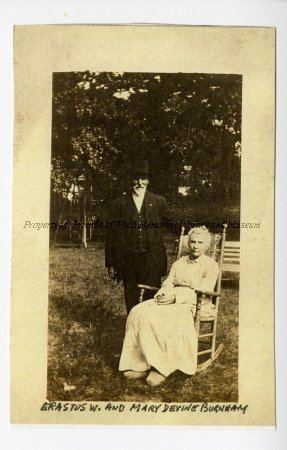 Mary Graham Devine Burnham
Children: Agnes Maria BurnhamCharles Lee BurnhamEmmeline M. Burnham KenyonHenry Erastus BurnhamFrederick BurnhamRobert L. BurnhamErastus Devine BurnhamWilliam Burnham (1856)