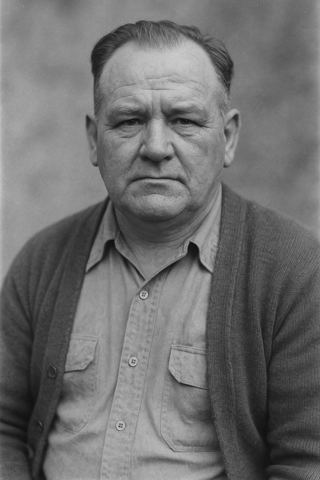
Krug line · Daniel's great-grandfather
Wilhelm Friedrich Krug
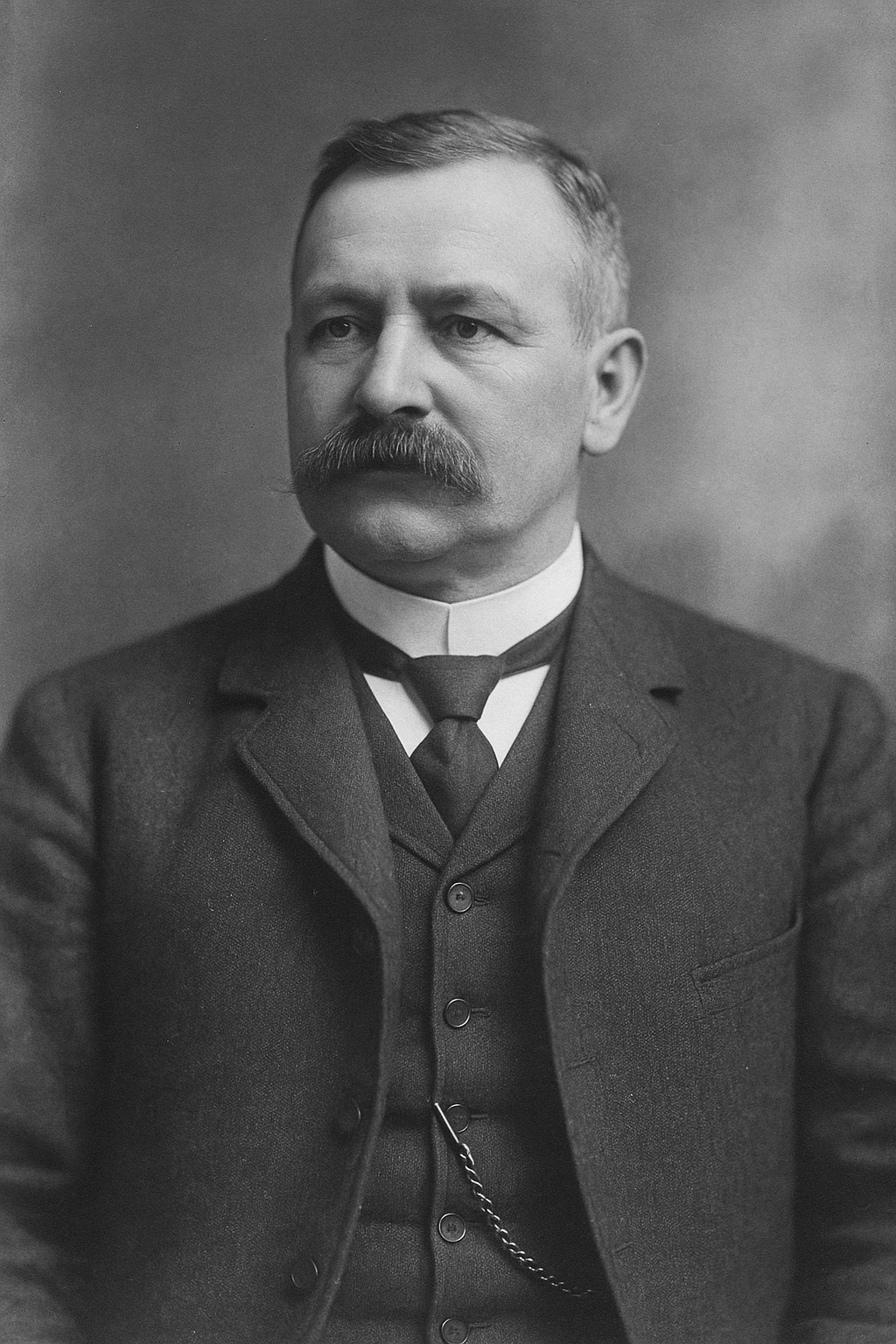 Wilhelm Krug (illustration; no photograph found) | |
| Other names | William Krug |
|---|---|
| Born | c. December 1855, Germany |
| Died | 1938 (family account) |
| Resting place | South Hadley, Massachusetts (family stone, per Daniel St. John) |
| Occupation | Mill employee; language teacher; department-store clerk; baker |
| Spouse | (1) a German-born wife, name unknown; (2) Agnes Maria Burnham (m. 1890) |
| Children | Hattie Krug; Flora; William Burnham Krug; Eleanor Krug |
| Relatives | Erasthus William Burnham Jr (father-in-law); E. Janet Krug (granddaughter); Daniel St. John (great-grandson) |
Wilhelm Friedrich Krug (c. 1855 – 1938), known in American records as William Krug, was a German-born immigrant who lived in Holyoke and then South Hadley, Massachusetts, where his home on Hadley Street was known locally as the "Krug Homestead".[1][2][3] Census records describe him over three decades as a teacher, a department-store clerk and a baker.[2][4][5] He was the father of William Burnham Krug and the great-grandfather of Daniel St. John, whose recorded interviews preserve the family's traditions about him, among them a story that he went to school with the future Kaiser Wilhelm II.[6][7]
Early life
Daniel St. John gave his great-grandfather's full name as Wilhelm Friedrich Krug.[1] The 1900 census records his birth in Germany in December 1855, to parents who were both born in Germany.[2] The 1910, 1920 and 1930 censuses give his age as 55, 65 and 75, which places his birth in 1854 or 1855, and the 1920 census gives his mother tongue as German.[4][5][8] His birthplace in Germany is not known; Daniel said that he hoped to research the Krug name "from this area".[9]
According to family tradition, Krug was educated at a gymnasium, studied Greek and Latin, and knew at least five European languages fluently.[6] The family also held that he had been a schoolfellow of Prince Wilhelm, later Kaiser Wilhelm II, and that the two had walked to school together, the prince being unable to join in the gymnastics or riding because of his arm.[6][10] Prince Wilhelm, born in January 1859, entered the Friedrichsgymnasium at Kassel in 1874 and left it with his Abitur in 1877.[11][12] Because the censuses place Krug's birth in 1854–55 and his emigration in the 1870s, the dates leave little room for the two to have been schoolboys together, and no record yet found names the school Krug attended.
Emigration and work
The censuses disagree on the year he came to the United States: the 1900 schedule gives 1876 or 1878 (the figure is overwritten), the 1910 schedule 1874, the 1920 schedule 1873, and the 1930 schedule 1889.[2][4][5][8] Daniel's account was that he emigrated "in his 20s" in the 1870s, herded cattle in the West, worked on the Erie Canal and saved his money before settling in Holyoke.[13] No record of his time in the West or on the canal has been found.
He was in Massachusetts by October 1882, when his daughter Flora was born there.[2] The 1885 Holyoke city directory lists a "Krug William, emp Connor Bros., house 665 Main"; Connor Brothers made woollen goods in the city.[14] A history of Holyoke published in 1895 records that at the Springdale Turn Hall "William Krug is employed to give instruction in German and English language".[15] In the 1900 census his occupation is "Teacher".[2] The naturalization column was left blank in 1900; in 1910 and 1920 he is marked as naturalized, and the 1920 schedule gives the year of naturalization as 1885 (the figure is hard to read).[2][4][5]
In 1910 he was working as a clerk in a department store, and in 1920, aged 65, as a baker in a bakery shop.[4][5] The family remembered his work differently: Daniel said that his "basic job was night guard" for Steiger's store in Holyoke, that "He had a gun and he was very reliable", and that he also interpreted in court and translated documents for Polish, French-Canadian and Italian immigrants.[16][17][6] No record of his court work has been found.
The family also recalled him as a gymnast at the Turnverein in Holyoke, doing handstands "right into, you know, I think his older age, 50s and 60s".[18]
Marriages and family
Krug's first wife was born in Germany, as the census entries for her daughters show; her name and the date of her death are not known.[2] Their daughters were Flora, born in October 1882, and Hattie (Harriette), born in February 1885, both in Massachusetts.[2] Daniel said that he had met both of them.[13] In March 1909 Flora was married at the Krug home on Hadley Street to Ralph Joseph McQuade of New York City, with the Congregational minister, the Rev. J. G. Nichols, officiating.[19]
After his first wife's death Krug married Agnes Maria Burnham, a daughter of the Civil War veteran Erasthus William Burnham Jr.[20][13] They were married in Holyoke on 1 October 1890 by the Rev. J. W. T. Boothe, pastor of the Second Baptist Church,; Krug, then a dry goods clerk, gave his age as 32 and his parents as William and Jeanette, and the register records it as his second marriage and her first.[21][22] The 1900 census records them as married ten years and the 1910 census as married eighteen, which places the marriage about 1890–92; in 1910 he is marked as in his second marriage.[2][4] Daniel supposed that Krug "must have hired her" to look after his daughters and later married her, which he presented as his own inference.[13] Agnes's family had moved to Holyoke in 1883.[20] The couple had a son, William Burnham Krug, born in December 1893, and a daughter, Eleanor Krug, born about 1900–01.[2][4]
South Hadley
Daniel said the family left Holyoke for property in South Hadley "around 1890".[23] By June 1900 the household lived on Hadley Street, South Hadley, in a house Krug owned free of mortgage.[2][24] In 1904 a William Krug of South Hadley, as executor of the estate of Abigail Brown, sold a tract at the head of Laurel Street in Holyoke for about $20,000.[25][26] For about two years before her death in January 1914, Miss Augusta Hawley, whose mother had been matron at Mount Holyoke College, made her home with him.[27]
By 1910 the property was an owned farm, free of mortgage.[4] In 1912 the South Hadley historian Sophie Eastman used "the Krug Homestead" as a landmark in describing an old highway.[3] A 1998 state act describing a parcel on Ferry Street refers to its boundary running "by land now or formerly of said Krug, sixty-two (62) rods and seven (7) links to a stone post".[28] In Daniel's words, "By those standards, they were probably the wealthiest people in South Hadley. They had all the prime land right at the crossroads and acres of land going right down to the river."[29] Daniel also said that after the First World War Krug sent money to relatives in Germany who were starving.[30][31]
In 1920 Krug, then 65, owned his house with a mortgage on it, and his son's family rented the house next door.[5] Between 1922 and 1928 he and Agnes sold six lots of land, the first of them in August 1922 to Owen W. Burnham, Agnes's brother.[32][20] On 11 February 1930 they deeded the home place to William B. and Elizabeth C. Krug.[32] When the census was taken on 23 April 1930, Krug was 75 and widowed, gave no occupation, and headed a household on Hadley Street that included his son's family; the house was valued at $10,000.[8] He was a party with his son and daughter-in-law to the town of South Hadley's taking of Krug land in October 1930, to the sale of land to the Evergreen Cemetery Association in August 1934, and to a deed of November 1936.[32]
Death
According to Daniel St. John, Wilhelm Krug died in 1938.[7] No death notice for him has been found in the digitized newspapers of the period, and his death record has not been examined. Daniel said that he is buried in South Hadley with his son, under the stone that also marks the graves of three generations of the family's women.[33][34]
Legacy
The family owns a large silver medal which, as Daniel understood it, the Kaiser had struck "for all of his fraternity brothers" to mark a 25th wedding anniversary.[35] Daniel said that he had kept the medal and later gave it to his uncle Daniel Burnham Krug.[36] The medal has not been examined or identified.
In the family's memory
"And they were quite wealthy because my German grandfather was a very hardworking gentleman, very effective gentleman of higher education in Germany. He actually went to school with the Kaiser of Germany. He went to school with Kaiser Wilhelm II when he was a teenager at the same, what they call the gymnasium. And he studied Greek and Latin." — Daniel St. John, interview recording S5, 00:29:12[6]
"Because he had gone to this very disciplined private school with the Kaiser, he was also heavily into gymnastics, which the Germans developed competitive gymnastics. … And that was his whole thing that when he wasn't working, he would be doing handstands and so forth right into, you know, I think his older age, 50s and 60s. He was a gymnast." — S5, 00:50:28[18]
"Yeah, so you're talking about, one, my grandfather's father who made so much, was such a disciplined person and made so much money for the family." — S5, 01:02:12[37]
In The Book of Daniel
Krug is the subject of the chapter Wilhelm Krug and appears in Grandfather Krug, Erasthus Burnham and Childhood.[38]
: Rex St. John, research notes, "Wilhelm Friedrich Krug: records and people" (Book-o-Matic project, October 2026), §§6–8, recording the searches of Chronicling America, the Internet Archive, the Holyoke city reports and the census indexes (family archive).
References
- Daniel St. John, interview recording S5, 00:30:12 (family archive).
- Twelfth Census of the United States, 1900, Massachusetts, Hampshire County, South Hadley, ED 648, sheet 11B, lines 84–88 (NARA microfilm T623, roll 654). Internet Archive. https://archive.org/details/12thcensusofpopu654unit/page/n776
- Sophie E. Eastman, In Old South Hadley (Chicago: Blakely Printing, 1912), p. 14. https://archive.org/details/inoldsouthhadley00east
- Thirteenth Census of the United States, 1910, Massachusetts, Hampshire County, South Hadley, ED 717, sheet 6A, lines 23–27 (NARA microfilm T624, roll 594). Internet Archive. https://archive.org/details/13thcensus1910po594unit/page/n230
- Fourteenth Census of the United States, 1920, Massachusetts, Hampshire County, South Hadley, Precinct B, ED 185, sheet 12A (NARA microfilm T625, roll 705), enumerated February 1920. Internet Archive. https://archive.org/details/14thcensusofpopu705unit/page/n249
- Daniel St. John, interview recording S5, 00:29:12 (family archive).
- Daniel St. John, interview recording S5, 01:01:55 (family archive).
- Fifteenth Census of the United States, 1930, Massachusetts, Hampshire County, South Hadley, ED 8-44, sheet 20A, lines 30–39, enumerated 23 April 1930 (NARA microfilm T626). Internet Archive. https://archive.org/details/massachusettscensus00reel913/page/n194
- Daniel St. John, interview recording S5, 01:15:43 (family archive).
- Daniel St. John, interview recording S5, 01:10:56 (family archive).
- "Friedrichsgymnasium Kassel", German Wikipedia (retrieved 5 October 2026). https://de.wikipedia.org/wiki/Friedrichsgymnasium_Kassel
- Wilhelm II, My Early Life (London: Methuen, 1926). Internet Archive. https://archive.org/details/dli.ministry.04560
- Daniel St. John, interview recording S5, 00:30:29 (family archive).
- Price & Lee, Holyoke, Massachusetts, City Directory (1885), p. 128. Internet Archive. https://archive.org/details/holyokemassachus00pric
- Holyoke, Past and Present, 1745–1895 (Holyoke: Transcript Publishing, 1895), pp. 158–159. Internet Archive. https://archive.org/details/holyokepastprese00unse
- Daniel St. John, interview recording S5, 00:52:01 (family archive).
- Daniel St. John, interview recording S5, 00:52:18 (family archive).
- Daniel St. John, interview recording S5, 00:50:28 (family archive).
- "South Hadley", Springfield Weekly Republican, 18 March 1909, p. 16. Library of Congress, Chronicling America. https://www.loc.gov/resource/sn83020847/1909-03-18/ed-1/?sp=16
- William Richard Cutter (ed.), Encyclopedia of Massachusetts, Biographical—Genealogical (New York: American Historical Society, c. 1922–25), "Burnham" article, p. 367. Internet Archive. https://archive.org/details/encyclopediaofma03incutt
- City of Holyoke, marriage register for 1890, p. 481, no. 360, William Krug and Agnes M. Burnham, 1 October 1890 (Massachusetts Vital Records, 1840–1911; copy supplied by the Holyoke History Room, Holyoke Public Library, 27 October 2026).
- G. C. Osgood, Story of the Holyoke Churches (Holyoke: Transcript Publishing Co., 1890), pp. 38–39 (Rev. J. W. T. Boothe, D.D., pastor of the Second Baptist Church from 1 January 1890).
- Daniel St. John, interview recording S5, 01:00:43 (family archive).
- 1900 United States Census Soundex, Massachusetts, code K620, "Krug, William" (NARA T1051, reel 162). Internet Archive. https://archive.org/details/soundex1900ma162
- Springfield Weekly Republican, 23 September 1904, p. 14. Library of Congress, Chronicling America. https://www.loc.gov/resource/sn83020847/1904-09-23/ed-1/?sp=14
- Public Documents of Massachusetts (1905): "William Krug, executor will of Abbigail B. Brown". Internet Archive. https://archive.org/details/publicdocuments59massgoog
- Springfield Weekly Republican, 15 January 1914, p. 11. Library of Congress, Chronicling America. https://www.loc.gov/resource/sn83020847/1914-01-15/ed-1/?sp=11
- Acts and Resolves Passed by the General Court of Massachusetts, 1998, chapter 200, pp. 992–993. Internet Archive. https://archive.org/details/actsresolvespass19982mass
- Daniel St. John, interview recording S5, 00:59:32 (family archive).
- Daniel St. John, interview recording S5, 01:13:15 (family archive).
- Daniel St. John, interview recording S5, 01:13:25 (family archive).
- Hampshire County Registry of Deeds, Recorded Land name index and document details, KRUG, 1921–1970: Book 782 p. 216 (7 August 1922, to Owen W. Burnham); Books 801 p. 409, 816 p. 288, 824 p. 16, 837 p. 80, 847 p. 240 (1924–28); Book 861 p. 144 (11 February 1930); Book 867 p. 523 (taking, 1 October 1930); Book 898 p. 56 (13 August 1934); Book 919 p. 35 (7 November 1936). https://www.masslandrecords.com/Hampshire/
- Daniel St. John, interview recording S5, 00:27:58 (family archive).
- Daniel St. John, interview recording S5, 00:28:27 (family archive).
- Daniel St. John, interview recording S5, 01:12:05 (family archive).
- Daniel St. John, interview recording S5, 01:10:25 (family archive).
- Daniel St. John, interview recording S5, 01:02:12 (family archive).
- Rex St. John, The Book of Daniel (2026), chapters "Wilhelm Krug", "Grandfather Krug", "Erasthus Burnham" and "Childhood".
Family
Spouse: Agnes Maria Burnham